Frequently Asked Questions
What people most often ask us about the Taíno people and the Concilio
If your answer is not here, write to us. We respond within two or three business days.
The Taíno people
Do Taíno people still exist today?
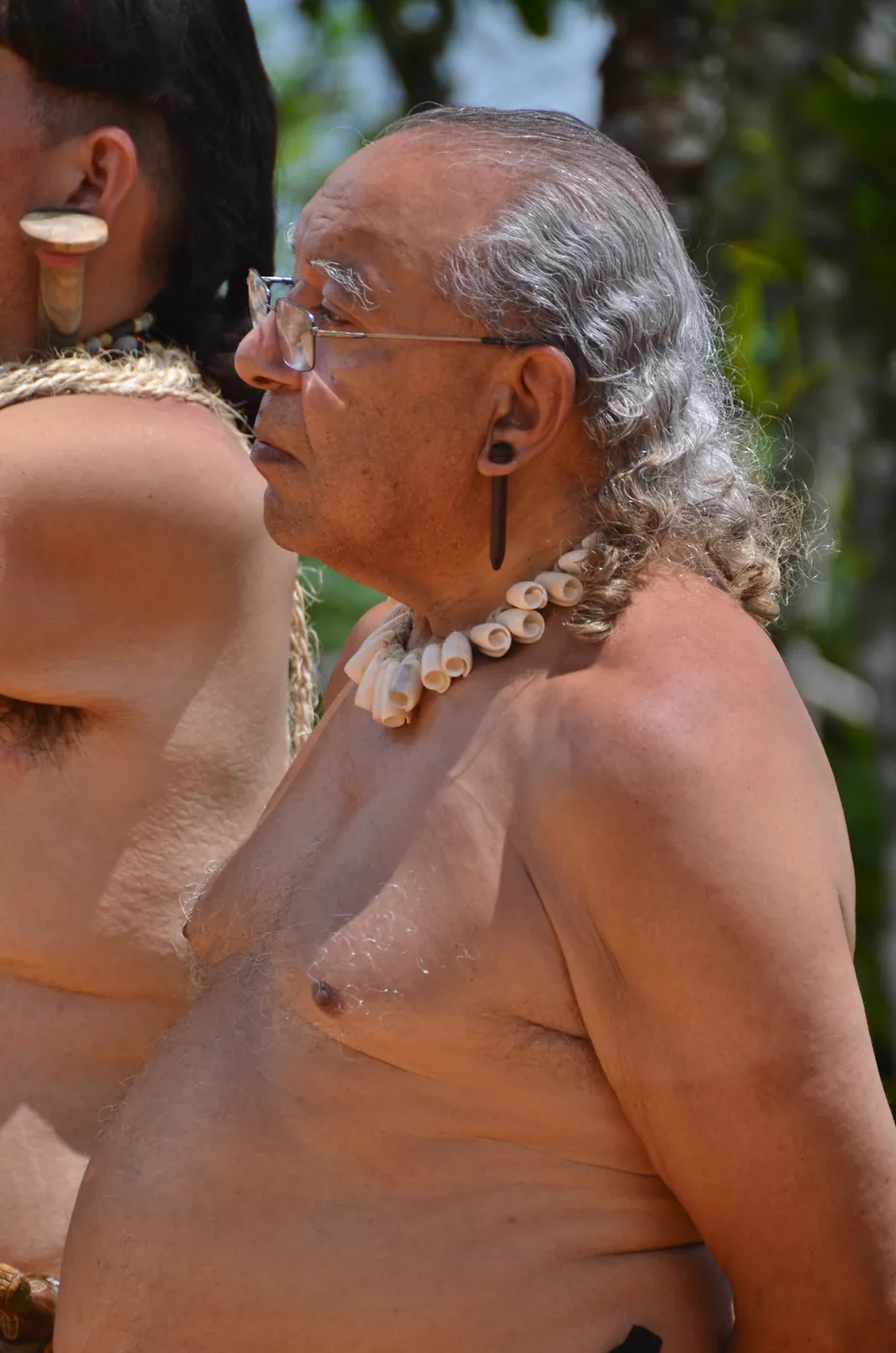
Yes. The claim that the Taíno people went extinct in the 16th to 18th century is contradicted by both genetics and living practice. Mitochondrial DNA research by Dr. Juan Carlos Martínez Cruzado at the University of Puerto Rico at Mayagüez found that between 61% and 76% of Puerto Ricans carry direct Taíno/Indigenous maternal lineage. The Concilio Taíno has operated continuously since 1992, with a named cacique, active ceremony, and school programs running today. The full research summary is on our About page.
What is the research behind the 61% to 76% figure?
It comes from the mitochondrial DNA studies of Dr. Juan Carlos Martínez Cruzado at the University of Puerto Rico at Mayagüez, which traced the maternal ancestry of Puerto Ricans. Mitochondrial DNA passes from mother to child, so it traces a direct maternal line. The full summary is on our About page.
What language did the Taíno people speak?
The Taíno language comes from the Arawak linguistic root. Many Taíno words remain in everyday Puerto Rican Spanish and Caribbean English: hurricane, hammock, barbecue, canoe and tobacco all come from it. Our Culture page carries a glossary of essential terms.
About the Concilio
What is the Concilio Taíno Guatú Ma Cú-A Borikén?
It is a nonprofit corporation founded in 1992 and incorporated in 2000, dedicated to preserving, teaching and restoring the culture, traditions, language and spirituality of the Taíno people of Borikén. Its work reaches hundreds of thousands of people locally and internationally. More on our About page.
What does the name Guatú Ma Cú-A Borikén mean?
It translates as Fuego Sagrado de Puerto Rico, the Sacred Fire of Puerto Rico.
Who leads the Concilio?
Cacique Ángel Kegaraniciba Benítez. He was named Nitaíno in 2013 and elected cacique in 2023 by the women of the community and by the community at large, under ancestral tradition. He succeeded the founder, Cacique Martín Cacibaopil Veguilla (1953–2023), who was the first cacique named in Borikén in 500 years. Both biographies are on our About page.
Is the Concilio recognized by any institution?
Both caciques have served as official consultants on Taíno traditions recognized by the Instituto de Cultura Puertorriqueña (ICP). The ICP produced three films with founder Martín Veguilla for its Cultura Virtual series, on the areíto, the making of casabe, and the batú ball game. All three are embedded on this site.
Is the Concilio a registered nonprofit?
Yes. The Concilio Taíno Guatú Ma Cú-A Borikén, Inc. is a federally recognized 501(c)(3) nonprofit organization, EIN 66-0615472. Details on how gifts are used are on our Support page.
Where is the Concilio located?
At the Centro Cultural Agüeybaná El Bravo, Carr. 335 INT. 582 Bo. Indios Sect. Rufina, Guayanilla, PR 00754. Postal mail goes to P.O. Box 561822, Guayanilla, PR 00656. Members and sister communities are also active in New York, Pennsylvania, Florida, Texas and Europe. Directions and every way to reach us are on our Contact page.
Taking part
Can I participate if I do not have Taíno ancestry?
Yes. Taíno ancestry is not a requirement. Anyone with a genuine interest in learning about and respecting Taíno culture is welcome. Participation in our community activities is free, and we ask only for mutual respect for our internal rules and ancestral code of ethics.
What activities does the community hold?
Monthly talks and cultural gatherings, communal casabe making on the traditional burén, the batú ball game, seasonal ceremonies for the solstices and equinoxes, and Taíno naming ceremonies and ancestral weddings. The full calendar is on our Community page.
How do I volunteer?
Write to us through the contact page and tell us how you would like to help. There are opportunities to teach, to organize events, and to support community initiatives.
Programs and presentations
Do you offer programs for schools?
Yes. We bring five workshops directly into classrooms: the Areíto workshop, ancestral pottery, traditional instruments, an introduction to the Taíno language, and the true history of the Taíno people. We also present at universities and government institutions.
How do I request a school visit?
Use the school visit request form on our Education page. We reply within three to five business days to confirm. The form asks for the school, grade level, location, preferred dates and an approximate number of students.
Do you present to groups other than schools?
Yes. We coordinate presentations for companies, community organizations, universities, cultural festivals and events. Choose "Coordinate a Presentation" as the inquiry type on our contact page.
Supporting the work
How can I support the Concilio?
You can make a one-time gift or join as a Guardián del Yukayeke with a recurring monthly contribution, both on our Support page. You can also volunteer, attend our activities, or share our work.
How are donations used?
Donations directly fund educational presentations in schools, pottery and crafts workshops, cultural ceremonies, bilingual educational materials, and Taíno language preservation.